


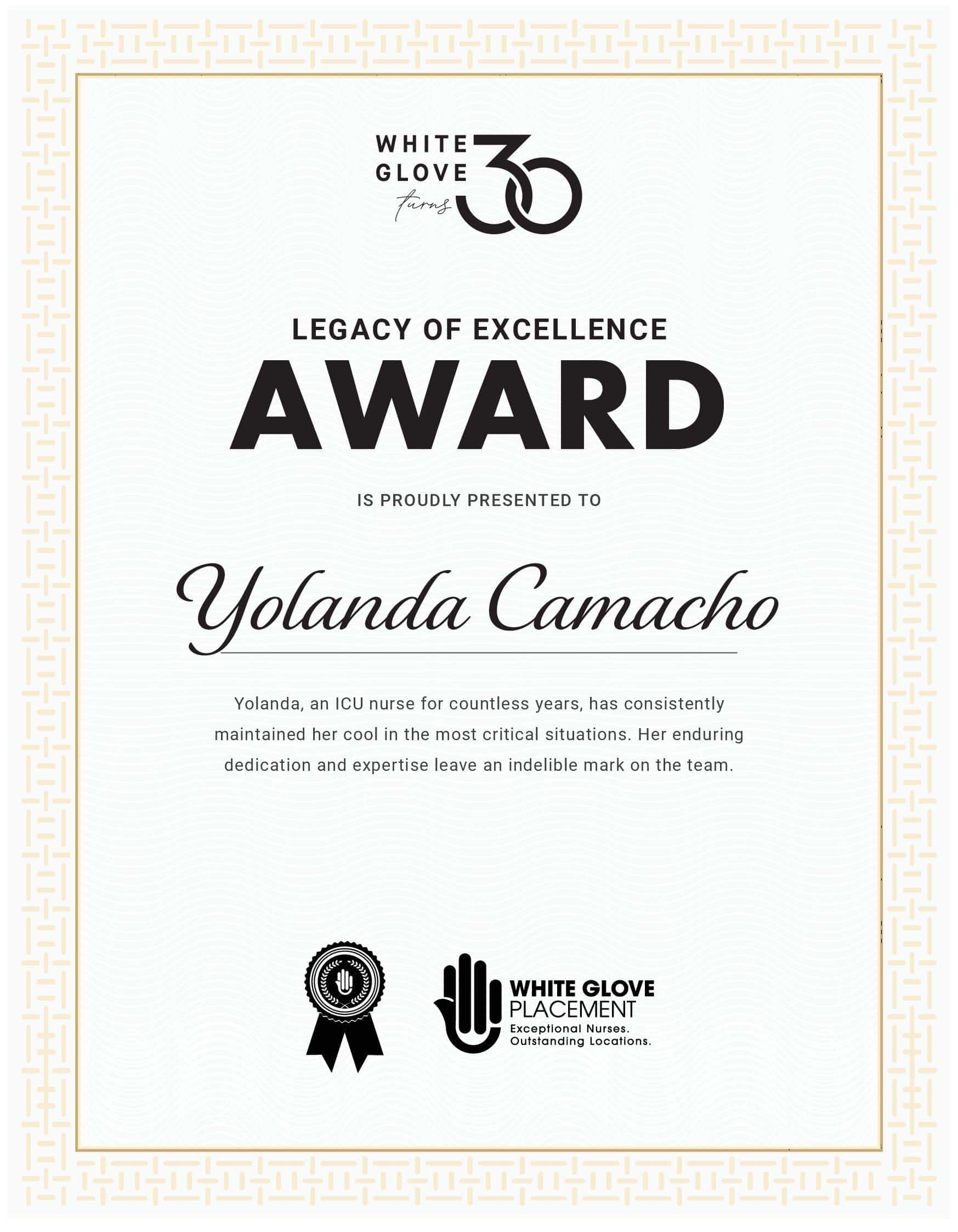
The Inspiring Story of Yolanda Comacho, ICU RN
Hi Yolanda, Tell us why you became a nurse.
In the Philippines, children cannot work if they do not attend school, so parents often pay for their college education. They even sell their livestock (many families have sheep and goats in the yard.) to send their children to university. That’s the culture. I remember wanting to become an engineer because I was good at math. However, my father advised me that there were no job opportunities in that field, so he suggested I become a nurse instead. As the one who paid for my tuition, I didn’t have much of a choice. I registered for nursing school, took the entrance exam, and passed.
I never regretted becoming a nurse. I really enjoy nursing; it’s so rewarding and therapeutic.
How was life in the Philippines, and how was your transition to the United States?
I graduated in 1983 and stayed in the Philippines for two years, where I worked in open heart surgeries in the Surgical ICU and the Medical ICU. In 1986, I was all of 23 and sponsored to the US along with another eight students to Brookdale Hospital.
We didn’t know each other beforehand and met at the airport. We were complete strangers to each other, but we had to share an apartment. We split into two apartments—five of us in one and three in another. We had all left our friends and family back home, which was hard.
The cultural shift from the Philippines to here was challenging, especially regarding food. I couldn’t eat pizza because it was different from what I was used to, and chicken was also a challenge. We didn’t have pots and pans at first, so we ate in the cafeteria. I’ll never forget my first meal! It was fried chicken and fried rice, barely going down my throat. I felt homesick.
Brookdale Hospital sponsored me with a working visa for a one-year contract, after which I had to take the state board exam. The education in the Philippines was very different, which made adapting here tough. One of the exam questions I’ll never forget asked which food is rich in iron, and one of the multiple-choice answers was broccoli. And I didn’t recognize broccoli. I had never ever seen broccoli in my whole life, and I didn’t even know what it looked like!
How was your nursing experience?
I’ve been a nurse for thirty-six years, and being adaptable has made me versatile. I also always held down two jobs, one primary and one per diem, adding to my experience. The intensive care unit was my starting point, but I’ve been in surgical ICU, interventional radiology, Stepdown, OB recovery, interventional radiology, and sometimes covered for ER, and even did visit nursing for some years.
My primary role, which I’ve had for too many years to count, I believe since 1994, is as the surgical ICU supervisor and orienting and training new nurses. As a supervisor, I managed many nurses and was responsible for developing policies and procedures for the ICU. Recently, after the pandemic, I’ve transitioned to teaching in other units, too.
Being in a supervisor role, how did COVID affect you?
From 2020 to 2021, I worked in a COVID ICU unit, which was extremely busy during the height of the pandemic.
It was chaotic, with so many patients and very few staff members. Frankly, I was scared, but I remember getting the courage from a dedicated CNA. COVID was airborne and so contagious, and there she was cleaning her patients, direct contact and all. She wasn’t afraid. Seeing her dedication inspired me to push through my own fear.
Since it was very hectic on the floor, I would help with direct patient care. On a day when we were taking care of a patient who coded, we were all masks and sheilds from head to toe. When the doctor told me which medication to hand him, but with all the PPE masking me up, I couldn’t hear him. So, without thinking, I applied my hands to my ear to uncover it. When I got home, I felt I didn’t feel right.
Soon, I was really not feeling alright, and before long, I was hospitalized in the very same COVID Unit where I supervised! I was on a trach, intubated, and couldn’t eat or breathe by myself. I spent over 100 days in the ICU. I would see the very same nurses I trained hover over me to care for me with the techniques I had taught them. The policies I created were applied to my life! It was so humbling!
It took me a long time to recover. I spent over 100 days in the ICU, then moved to the step-down unit. After that, I attended therapy to relearn how to eat and walk. But now, here I am, stronger and more determined than ever.
I love sharing my knowledge because I know that one day, I might find myself in a hospital bed, and I want to ensure that the nurses who care for me are well-informed.
Any patients or stories that left an impression on you?
One memorable experience occurred while I was supervising in the ICU. I remember a middle-aged man who was very ill. While doing it on him, I showed the nurses how to catheterize a patient. He looked at me and said, “Don’t leave me.” And I stayed there to calm him for a couple of hours. When the clock struck four and I turned to leave, he pleaded, “Please don’t leave me.” It took him a couple of months, but he eventually improved and got back on his feet.
I also recall this man I cared for back in the ’90s; he was a truck driver who had suffered an aneurysm. After the surgery performed by a specializing surgeon, he completely recovered and drove his truck again. He would then stop by to say hello and thank us every time he passed by. One day, I asked him why he continued to come back. He replied, “When I was in bed, I knew you were there for me.” He added, with a chuckle, “I saw you all the time because you were on top of me.” His bed was rather high, and since I am short, it required me to use a stool to reach him, so I must have been quite literally above him.
Another patient I remember had a stab wound to the heart. A rich guy who owned a chain store, he survived the ordeal. We had to open his chest, and the doctor changed the dressing every day. Years later, while I was working in radiology doing CT scans and MRIs, he came for a scan to make sure everything was alright with his injured arm. I recognized his name and confirmed it when I saw the x-ray results. After the stab wound, they couldn’t fully close his chest, so it remained a distinct shape. Before COVID, he returned, and he was doing well at 62 years old. But he did not recognize me. I was just 24 when he was stabbed, and seeing him again at 55, more than 30 years later, felt incredibly rewarding.
There are so many more stories, so many patients but I don’t remember all of them. Usually, I don’t remeber all my patients as long as I feel I did the best I could for them.
Intensive care is intense indeed! Do you challenges when working in the unit?
ICU always presents challenges in patient care. I find it hard when I believe a patient can improve, but the family decides to pursue a DNR/DNI. You can see the patient doing better, but they start declining. It’s also frustrating when patients don’t want to be admitted to the ICU after a rapid response on the floor. Just because a patient has a DNR doesn’t mean we shouldn’t provide treatment, but somehow, once patients are under this status, people are subconsciously more lax about other aspects of the care, too.
It can also be difficult when a medical doctor is new to the profession, having just graduated and lacking experience. You may see things that could be done, but the doctor might hesitate to order interventions. I always advocate for my patients by suggesting to the doctor what might be necessary.
What are your plans for the future of your career?
I want to retire, but I can’t really imagine myself staying home all the time. My son tells me, “Mom, you’re going to be working until you’re 100.” Many of my friends, who are nurses and retired five years ago, ended up teaching in college. I’m considering whether I would like to teach when the time comes. I love sharing helpful knowledge.
Have you seen AI being integrated into diagnosis and treatment?
I haven’t seen AI being implemented significantly yet. While I have heard of some cases, it’s still very experimental. There was an x-ray that AI analyzed and indicated a fracture, but the doctor couldn’t actually find it. Perhaps one day AI will be able to provide more reliable assistance.
Do you get to be a nurse outside the scope of your job?
Yes, a lot of my friends, neighbors and collegues ask for my advice. I give them my honest opinion but do not tell them what to do.
Who are the people and hobbies who keep you going?
I cherish the support from my nurse friends. Remember my friends who were sponsored with me? We still keep in touch, forming our little community.
My husband died young. I raised my two boys alone; these friends were like family to me, the adopted aunts from my children. We celebrated many Thanksgivings together.
Now, my boys are all grown, and I am so happy to finally be at this point. The older one is a father to a five-year-old son. Take it from the grandma—he’s the cutest thing ever! I enjoy babysitting him, and we often go to the park.
What advice would you give to someone considering a career in nursing?
I would advise them to go for it. Even if they don’t have a passion for it before they start, it will develop over time. I myself never wanted to be a nurse, and here I am, doing it for more than 36 years and liking every minute.
I encouraged my sons to become nurses. The older one is already working and is a father to a boy, while my younger one just graduated from Hunter College and will go into nursing once he takes the state board exam.
Thank you, Yolanda, for joining us! Good luck with all you do!











 Job ID