

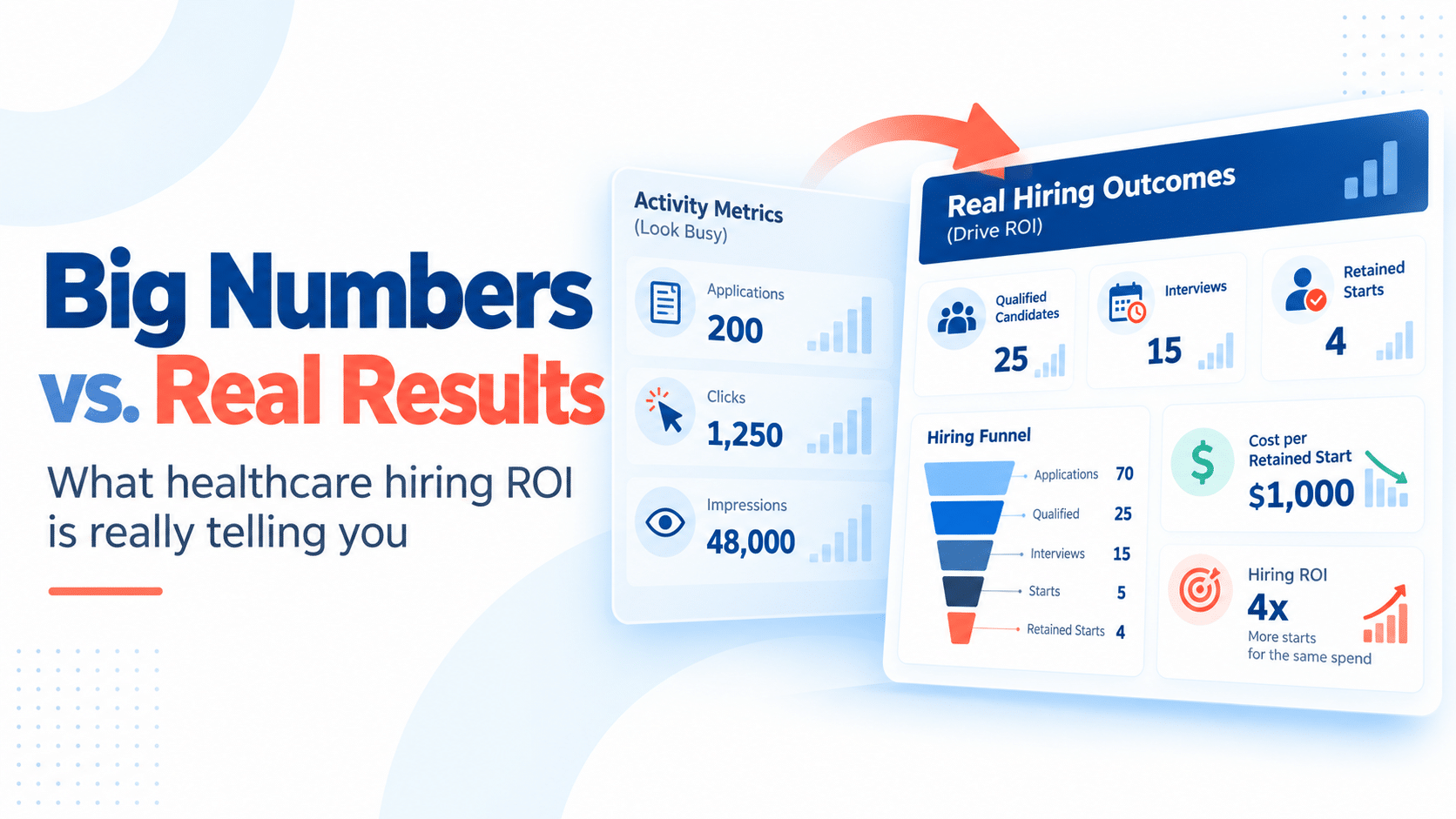
Type “top healthcare hiring sites” into Google, (or ask AI!) and you will find page after page of options: general job boards, healthcare marketplaces, nursing platforms, allied health sites, physician networks, locum tenens databases and professional association career centers. Every platform promises extensive reach, qualified candidates and faster hiring—usually supported by impressive numbers and metrics designed to win your organization’s business.
The truth? Many of them can bring you candidates. But the site that brings the most candidates is not necessarily the one producing the best return. One platform may generate hundreds of applications but very few qualified clinicians. Another may send fewer applicants, yet produce more interviews and starts.
Instead of asking only:
“Which hiring site brings the most applicants?”
Ask:
“Which hiring tool produces the strongest results for what we spend?”
To answer that question, you need to understand the basic recruiting vocabulary, follow candidates through the full hiring funnel and compare every tool using the same measurements.
What Does ROI Mean in Healthcare Hiring?
ROI stands for return on investment. In simple terms, it measures what you receive in return for the money and resources you spend.
In healthcare recruiting, ROI is not just about how many people apply. It is about how efficiently a hiring tool helps you reach clinicians who are qualified, interested, reachable and able to start.
A tool may be inexpensive but deliver almost no usable candidates. Another may cost more but produce multiple qualified hires. The lower-priced tool is not automatically the better value.
The basic formula for ROI is:
ROI = (Value produced − Cost of the tool) ÷ Cost of the tool × 100
However, the “value produced” by a hiring tool is not always easy to express as one dollar amount. For day-to-day recruiting decisions, the clearest approach is to compare several practical costs and conversion rates, especially:
- Cost per applicant
- Cost per qualified applicant
- Cost per interview
- Cost per start
- Cost per retained start
- Time to produce a qualified candidate
- Time to produce an actual start
These numbers show whether a tool is creating activity or truly moving hiring forward.
Understand the Healthcare Hiring Funnel
A candidate does not move directly from seeing a job post to starting work. Every source should be measured through the same funnel:
Impression → Click → Application → Contact → Qualification → Interview → Offer → Acceptance → Credentialing → Start → Retention
Each stage answers a different question:
- Are enough clinicians seeing the job?
- Are they interested enough to click?
- Are they completing the application?
- Can your recruiters reach them?
- Do they meet the job requirements?
- Are they genuinely interested and available?
- Do they advance to an interview?
- Do they accept and complete the hiring process?
- Do they start and remain in the role?
The further candidates move through the funnel, the more valuable the source becomes.
A platform that generates 200 applications but only one start may have a weaker return than a platform that generates 40 applications and four starts. Application volume tells you how busy the top of the funnel is. It does not tell you whether the tool is successfully filling jobs.
Essential Recruiting Vocabulary—Explained Clearly
Before comparing hiring tools, make sure everyone reviewing the results is using the same definitions.
- Impressions: The number of times your job appears in search results or on someone’s screen. This measures exposure—not interest.
- Clicks or job views: The number of people who open the listing. This shows whether the job title, location, pay, or other visible details are gaining attention.
- Applicant or lead: Someone who applies, shares their information, or expresses interest. This measures initial response, but not candidate quality.
- Qualified applicant: A candidate who meets the position’s essential requirements, including license, specialty, experience, location, and availability. This shows whether the tool is reaching the right audience.
- Active candidate: A clinician who has recently searched for jobs, applied, updated a profile, or confirmed availability. Active candidates are generally more likely to respond and consider an opportunity now.
- Passive candidate: A clinician who may qualify for the position but is not actively seeking a new job. These candidates can be valuable but often require more outreach and follow-up.
- Contact rate: The percentage of candidates who respond to recruiter outreach. This helps determine whether leads are current, reachable, and engaged.
- Conversion rate: The percentage of candidates who advance from one hiring stage to the next. This helps identify where the process is working—and where candidates are being lost.
- Source of hire: The platform or channel that originally produced the candidate. Tracking this allows you to credit results to the correct hiring tool.
- Cost per applicant: Total tool spend divided by the number of applications received. This measures the cost of generating volume, not quality.
- Cost per qualified applicant: Total tool spend divided by the number of applicants who meet the position’s requirements. This shows what it costs to reach a viable candidate.
- Cost per interview: Total tool spend divided by the number of interviews produced. This shows whether applicants are advancing beyond the initial stages.
- Cost per start: Total tool spend divided by the number of clinicians who begin working. This is one of the clearest measures of actual hiring performance.
- Cost per retained start: Total tool spend divided by the number of clinicians who start and remain for a defined period. This prevents early turnover from making a source appear more successful than it is.
- Time to fill: The number of days between opening a position and accepting an offer or filling the role. This measures the speed of the hiring process.
- Time to start: The number of days between opening the position and the clinician’s first day of work. This is especially important in healthcare, where credentialing can delay a start.
Important: Platforms may define their numbers differently. “Registered members,” “monthly visitors,” “active users,” “job seekers,” and “applications” are not interchangeable. Before relying on a vendor’s audience size, ask exactly what the number includes and how recently those candidates were active.
Calculate the Cost of Each Hiring Tool
Begin with the amount paid directly to the platform:
- Subscription or contract cost
- Individual job-posting fees
- Sponsored listing or pay-per-click spend
- Candidate-database access
- Recruiter seats or licenses
- Additional messaging or advertising fees
This gives you the direct tool cost.
For a deeper ROI review, you can also calculate the fully loaded cost. This includes the internal time and resources required to turn the tool’s candidates into hires, such as:
- Recruiter hours spent sourcing and reviewing
- Time spent contacting unresponsive leads
- Screening and interview coordination
- Hiring-manager time
- Additional recruiting technology
- Repeated work caused by duplicate or outdated candidates
Direct cost is useful when the internal effort is roughly equal across platforms. Fully loaded cost is better when one tool requires significantly more recruiter time than another.
For example, two sites may each cost $3,000. If one produces organized, current and responsive candidates while the other requires hours of searching through outdated profiles, their real costs are not equal.
The Most Useful ROI Formulas
Use the same formulas for every tool and the same time period.
Cost per applicant
Total tool spend ÷ Total applications
This measures how cheaply the platform creates volume. It does not show whether the applicants are qualified.
Qualification rate
Qualified applicants ÷ Total applications × 100
This shows how closely the platform’s candidates match your actual job requirements.
Cost per qualified applicant
Total tool spend ÷ Qualified applicants
This is far more meaningful than cost per applicant because it removes candidates who could never fill the job.
Contact rate
Candidates who respond ÷ Candidates contacted × 100
Low contact rates may indicate stale leads, passive candidates or slow recruiter follow-up.
Interview conversion rate
Interviews ÷ Qualified candidates submitted × 100
This shows whether the candidates considered qualified by recruiters also meet the hiring manager’s expectations.
Cost per start
Total tool spend ÷ Clinicians who start
This is one of the strongest ways to compare hiring tools because it connects spending to a real hiring result.
Cost per retained start
Total tool spend ÷ Starts who remain through your chosen milestone
Choose one consistent milestone, such as 30, 60 or 90 days, depending on the type of position. For contract roles, you may use assignment completion instead.
A Simple Example: Which Hiring Tool Has the Best ROI?
Imagine that you test three hiring platforms for similar positions during the same period:
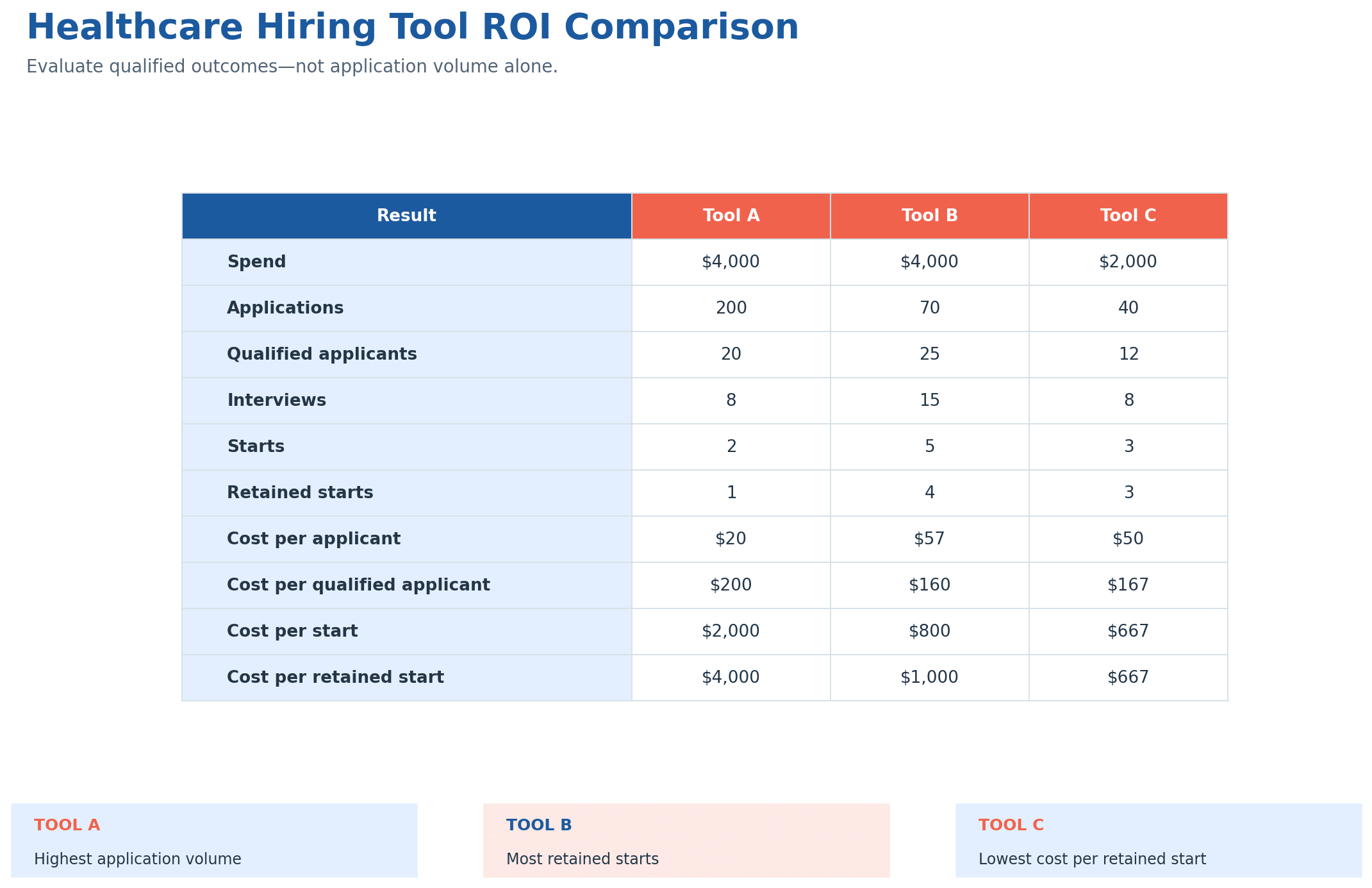
Insert Chart
If you look only at applications, Tool A appears to be the winner. It brought in 200 candidates at only $20 per application.
But Tool A produced only two starts, and only one remained through the retention milestone. Its lowest cost per application turned into the highest cost per retained start.
Tool B produced the largest number of retained hires. It may be the strongest choice when hiring volume is the priority.
Tool C produced fewer total hires but had the lowest cost per retained start. It may be the strongest choice when budget efficiency is the priority.
This example shows why “best ROI” does not always mean “most applicants” or even “most hires.” The answer depends on whether your immediate goal is volume, speed, quality, retention or cost efficiency.
How to Compare Different Hiring Tools Fairly
1. Compare similar jobs
Do not compare results from an easy-to-fill day position in a major city with a specialized night position in a rural market. Use jobs with comparable specialties, locations, shifts, pay and urgency.
2. Use the same definitions
Decide exactly what counts as an applicant, qualified candidate, interview, start and retained start. Apply those definitions across every platform.
3. Track every candidate source
Use tracking links, source codes or consistent applicant-tracking-system fields. If the source is missing, the ROI cannot be calculated accurately.
4. Deduplicate candidates
The same clinician may apply through several platforms. Choose one attribution rule—such as first source or most recent source—and use it consistently.
5. Keep response times equal
If applicants from one site receive a call within minutes while applicants from another wait two days, you are testing recruiter speed as much as platform quality.
6. Measure the entire funnel
Do not stop at clicks or applications. Continue tracking through interviews, offers, starts and retention.
7. Review results by category
A platform that works well for travel RNs may perform poorly for respiratory therapists or locum physicians. Break results down by discipline, specialty, location and job type before making a final decision.
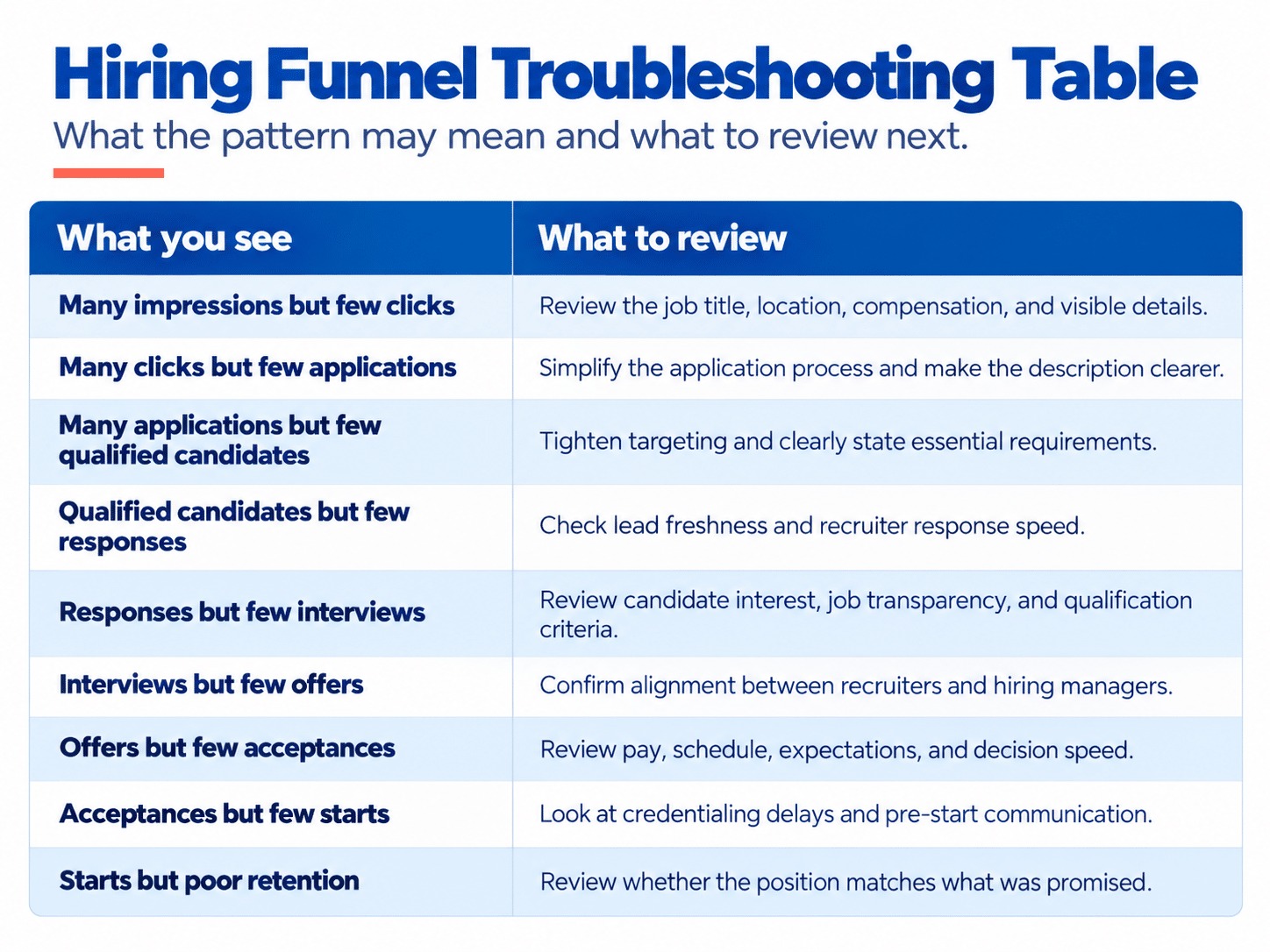
When Results Are Weak, Find the Funnel Problem
Before canceling a tool, identify the stage where candidates are being lost:
- Many impressions but few clicks: Review the job title, location, compensation and visible details.
- Many clicks but few applications: Simplify the application and make the description clearer.
- Many applications but few qualified candidates: Tighten targeting and clearly state essential requirements.
- Qualified candidates but few responses: Check lead freshness and recruiter response speed.
- Responses but few interviews: Review candidate interest, job transparency and qualification criteria.
- Interviews but few offers: Confirm alignment between recruiters and hiring managers.
- Offers but few acceptances: Review pay, schedule, expectations and decision speed.
- Acceptances but few starts: Look at credentialing delays and pre-start communication.
- Starts but poor retention: Review whether the position matches what was promised.
Sometimes the platform is the problem. Sometimes the job posting or recruiting process is the problem. ROI tracking helps you see the difference.
Build a Simple Hiring-Tool Scorecard
Use the same scorecard every month or quarter:
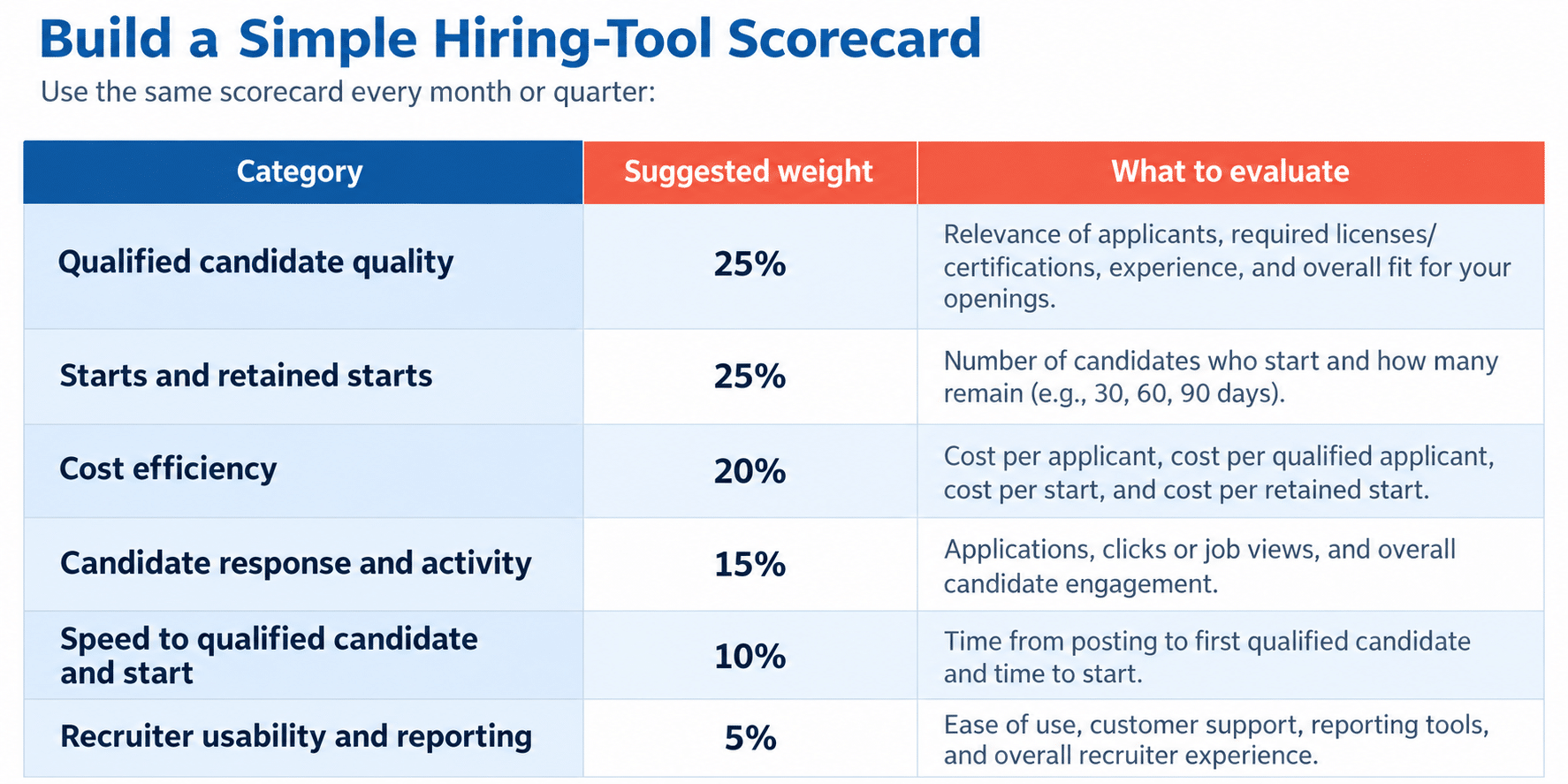
The weighting can change based on your needs. If a position is urgent, speed may matter more. If turnover is high, retained starts should carry more weight.
What matters is that each tool is judged by the same standards—not by the strongest number in its sales presentation.
The Bottom Line: Follow the Results
There is no hiring tool that performs best for every healthcare role, location and organization. The right mix may also change over time.
Do not get overly excited by a large number of applicants. Do not assume the cheapest subscription offers the best value. And do not continue paying for a tool because it is popular or familiar.
Track the full funnel. Learn the vocabulary. Compare qualified candidates, interviews, starts, retention, speed and cost. Keep investing in the tools that prove their value, improve the listings or processes that are limiting results and pause the sources that consistently fail to convert.
In some cases, an organization may discover that the combined cost of several platforms—plus the recruiter time required to manage them—is greater than the cost of getting outside hiring support from a solid healthcare staffing agency like White Glove.
Seeking a Hiring Partner that Delivers Every Time?
White Glove Placement is more than a healthcare hiring tool—we’re a team focused on delivering the outcomes that matter. We help healthcare organizations fill nursing, allied health, and advanced-practice needs through travel, local, per-diem, , and permanent placement solutions. If your current hiring tools are generating activity but not enough qualified candidates, starts, or long-term results, reach out. Let’s take a closer look at what you need and build a smarter path forward.












 Job ID


