


Travel nursing is all about opportunity: new places, new experiences, and the freedom to take assignments where your skills are needed most. But when you want to work across multiple states, licensing can quickly become one of the biggest roadblocks.
Compact licensure was created to make that process easier for eligible nurses. With one multistate license from your home state, qualified RNs, LPNs, and LVNs can practice in other compact states without applying for a separate license every time.
This guide is meant to help simplify the compact licensure process, but requirements, fees, timelines, and compact status can change. Before applying or accepting an assignment, always double-check the most current information with the official Nurse Licensure Compact website and your state Board of Nursing.
What is the nurse licensure compact?
A compact license or a multistate license allows an eligible RN, LPN, or LVN to practice in other compact states with a single license from their home state. It does not apply to APRN licenses. APRNs need separate APRN licensure for each state where they practice.
A compact license is issued by the state where the nurse legally lives. This is called the Primary State of Residence, or PSOR. The license is then recognized by other compact states.
As of the current Nurse Licensure Compact site, 43 jurisdictions are currently part of the NLC, though some have enacted the compact and are still awaiting full implementation.
How do I apply for a compact state nursing license?
Step 1: Make sure your home state is a compact state
You can only get a compact license if you legally live in a compact state.
Your home state is not just where you work. It is where you legally reside.
Proof of residence may include:
- Driver’s license
- Voter registration
- Federal tax return
- W-2
- Military Form 2058
You can only have one Primary State of Residence. Owning property in a compact state does not count by itself.
Step 2: Know which application you need
If you are a new nurse
Apply for a License by Exam in your home state. This is usually for new graduates taking the NCLEX.
If you already have a nursing license in another state
Apply for a license by Endorsement in your new home state. People often call this “transferring” a license, but technically you are applying for a new license based on your existing license.
If you already have a single-state license in your home state
Apply for an Upgrade or Conversion to a multistate license through your state Board of Nursing.
If you are renewing
Some states allow multistate renewal through the regular renewal process. Rules, fees, and continuing education requirements depend on your state Board of Nursing.
Step 3: Apply through your state Board of Nursing
You do not apply through every compact state. You apply through your home state Board of Nursing. Compact license applications, fees, background checks, CE requirements, and application status updates are all processed by the Board of Nursing.
Step 4: Make sure you meet the basic compact requirements
To qualify for a compact license, you generally must:
- Legally live in a compact state
- Meet your home state’s nursing license requirements
- Graduate from an approved nursing program
- Pass the NCLEX-RN or NCLEX-PN
- Have an active, unencumbered license
- Complete state and federal fingerprint-based background checks
- Have no felony conviction under state or federal law
- Have no nursing-related misdemeanor issue, unless reviewed and allowed by the Board
- Not be currently participating in an alternative or disciplinary program
- Have a valid U.S. Social Security number
Step 5: Complete fingerprinting and background check
A compact license requires a state and federal fingerprint-based criminal background check. Your Board of Nursing will tell you how to complete this step after you apply. Do not skip this step. Your application usually will not move forward without it.
Step 6: Wait for the Board to review
The Board will review:
- Your education
- Your NCLEX status
- Your license status
- Your residency proof
- Your background check
- Any discipline or criminal history
- Whether you qualify for compact status
If you qualify, you receive a multistate license. If you do not qualify for compact status, the Board may still issue a single-state license, depending on your state and situation.
Step 7: Check if your license is single-state or multistate
Do not assume your license is compact just because your state joined the compact. Check your license status through Nursys QuickConfirm. The NLC FAQ says nurses can use QuickConfirm at no cost to see whether a license is single-state or multistate.
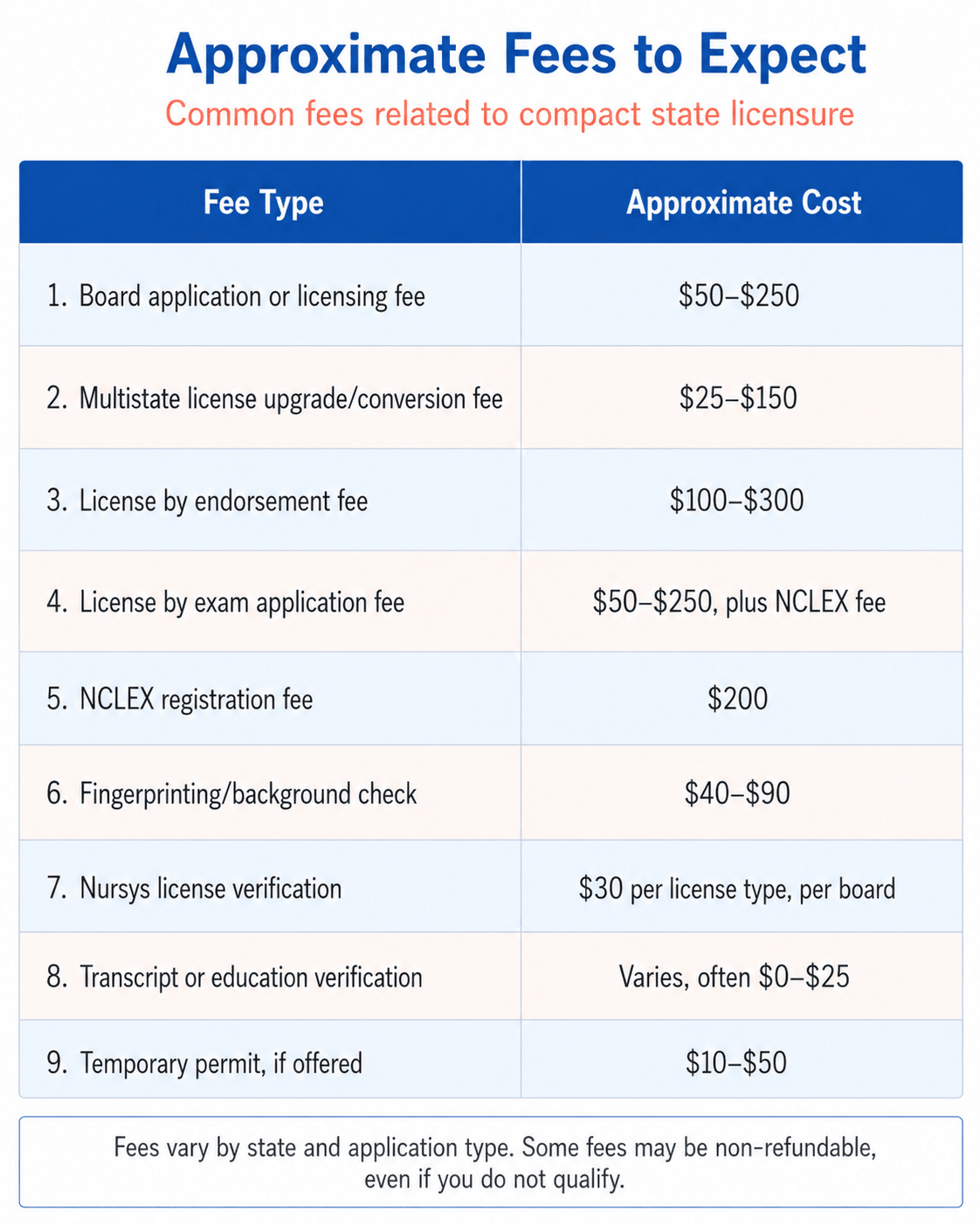
Approximate Fees to Expect
Fees vary by state, application type, and Board of Nursing requirements, so always check your home state Board of Nursing before applying. Some fees may also be nonrefundable, even if you apply incorrectly or do not qualify for a multistate license.
New Jersey example
New Jersey is part of the Nurse Licensure Compact.
If you already have an active NJ RN or LPN license
You do not automatically have a multistate license. You must apply through the NJ Board for a License by Upgrade.
If you are applying for your first NJ RN or LPN license
Apply as an RN Candidate or LPN Candidate. If you meet compact requirements, New Jersey says a multistate compact license will be issued.
If you only want to work in New Jersey
You do not need a compact license to keep working in New Jersey if you already have an active NJ RN or LPN license.
If you move to another compact state
If you move from one compact state to another and change your legal residence, you must apply for a new multistate license in your new home state within 60 days. This rule took effect January 2, 2024.
Example: You live in New Jersey and have an NJ compact license. Then you move your legal residence to Pennsylvania. You must apply for a Pennsylvania multistate license within 60 days of moving.
Compact licenses do not cover noncompact states
A compact license only gives you authority to practice in compact states.
If you want to work in a noncompact state, you still need to apply for that state’s license by endorsement. Nurses must be licensed in the state where the patient is located at the time care is provided.
Nursing licensure compact states & jurisdictions
Fully implemented compact states
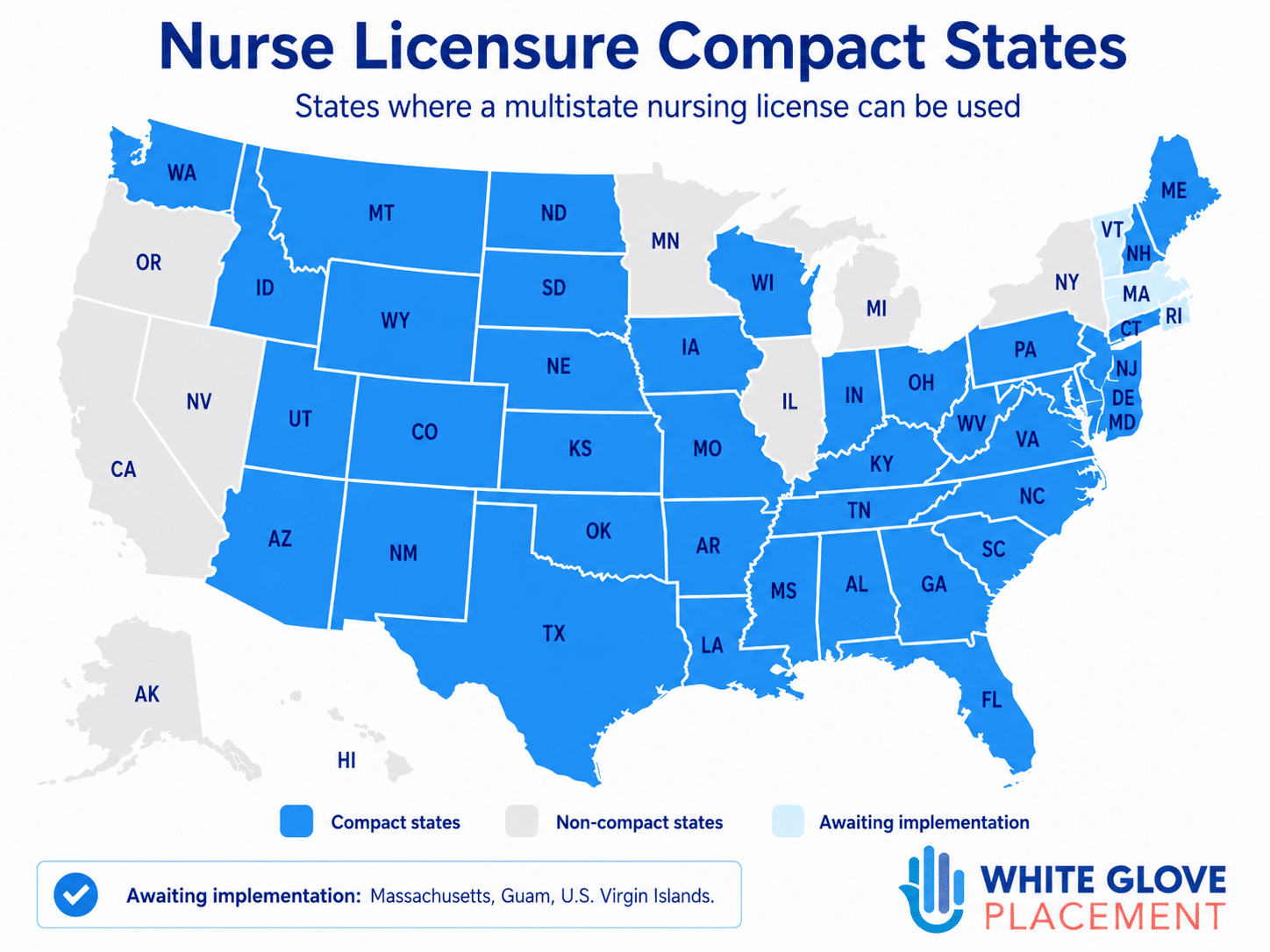
Alabama
Arizona
Arkansas
Colorado
Connecticut
Delaware
Florida
Georgia
Idaho
Indiana
Iowa
Kansas
Kentucky
Louisiana
Maine
Maryland
Mississippi
Missouri
Montana
Nebraska
New Hampshire
New Jersey
New Mexico
North Carolina
North Dakota
Ohio
Oklahoma
Pennsylvania
Rhode Island
South Carolina
South Dakota
Tennessee
Texas
Utah
Vermont
Virginia
Washington
West Virginia
Wisconsin
Wyoming
Enacted, but awaiting full implementation
Massachusetts
Guam
U.S. Virgin Islands
Compact licenses are not available from these jurisdictions until full implementation is complete.
Your license can take you places.
Browse White Glove travel nursing assignments and find the role that matches your experience, your expectations, and your next big opportunity.













 Job ID


